From first note,
to final exam
The only app you need to study, organize, and ace your exams.
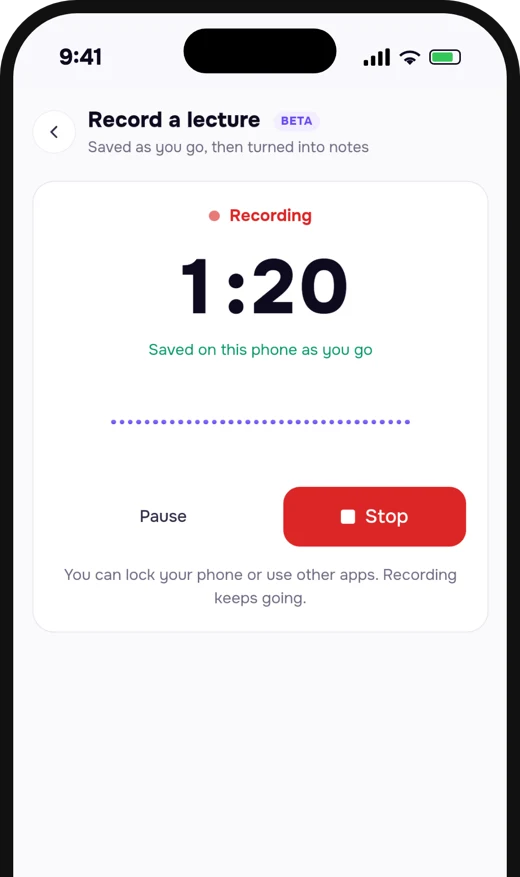
Record the lecture. Skip the note-taking.
Listen in class. Nuros writes the notes.
- ✓Press record when class startsOn your laptop or phone. Saved as you go, so nothing is lost.
- ✓Notes when class endsNuros turns the lecture into structured notes you can quiz and turn into flashcards.
- ✓Play it back with the transcriptFind exactly what your professor said, right in the note.
- ✓On every plan1 hour free, 6 hours a month on Plus, unlimited on Premium.
Smart notes that understand context
Structured notes from any source — PDF, link, YouTube, or a topic.
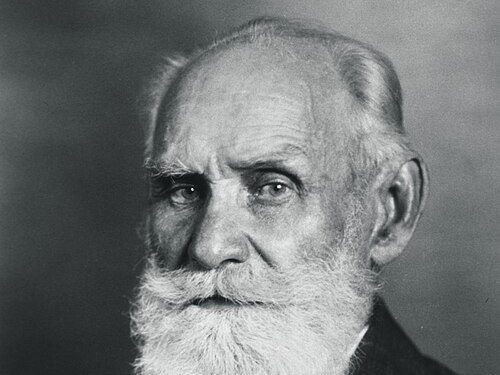
Classical conditioning is a form of associative learning in which a neutral stimulus, after repeated pairing with a stimulus that naturally triggers a response, comes to trigger that response on its own. It matters because Ivan Pavlov's experiments with dogs around 1900 and Watson and Rayner's 1920 "Little Albert" study showed that physical and emotional responses can be learned — a foundation of behaviorism and of modern exposure therapy for phobias.
This note explains:
- Pavlov's Experiments
- Unconditioned vs. Conditioned Stimuli
- Acquisition and Timing
- Extinction and Spontaneous Recovery
- Generalization and Discrimination
- Little Albert and Conditioned Emotions
- Classical vs. Operant Conditioning
- Applications in Therapy
Every classical conditioning setup has four parts: an unconditioned stimulus (food) that naturally produces an unconditioned response (salivation), and a conditioned stimulus (a metronome) that, once learned, produces a conditioned response…
 AI
One note. Every way to study it.
Quizzes, flashcards, podcasts, and video lessons — one click each.
For p(x) = x³ − 3x + 2, what is the maximum number of real roots?
Where it went wrong: you treated turning points as the limit — the degree alone sets the maximum. Revisit: "2. Polynomial Functions" in your note.
An AI conversation about your note — listen on the commute, replay the hard parts.
A narrated video lecture, slide by slide from your note.
Slide 1 of 8Upload your syllabus. Get a plan to the final.
Nuros reads your course syllabus — topics, quiz and exam dates, days off — and turns it into a dated study plan that builds notes and quizzes week by week. Or start from any topic. Syncs with your calendar.
Turn your sources into a real exam
A timed exam from your sources — graded, with a readiness score.
Pick which types the AI may generate.
You're losing points on the Electron Transport Chain. Nuros tracks it across every quiz and exam — and your study plan adapts automatically.
Practice this concept →Your personal AI study assistant
A mentor that knows your notes and adapts to you.
Nuro AI
Your smart, personalized learning assistant
- Unconditioned stimulus (US) — naturally triggers a response without learning, like food making Pavlov's dogs salivate.
- Conditioned stimulus (CS) — a neutral cue, like a metronome, that triggers the response after being paired with the US.
- Acquisition — the association builds over repeated pairings, fastest when the CS comes just before the US.
- Extinction & spontaneous recovery — the response fades when the CS appears alone, then can briefly return after a rest.
- Little Albert (1920) — Watson and Rayner showed emotions like fear can be conditioned too.
Here's a quick quiz on Classical Conditioning. Ready?
- 1.In Pavlov's experiments, what was the unconditioned stimulus?
- 2.What is it called when a conditioned response fades because the conditioned stimulus keeps appearing without the unconditioned stimulus?
- 3.Which researchers conditioned a fear of a white rat in "Little Albert"?
- 4.What is it called when a response also occurs to stimuli similar to the conditioned stimulus?
- 5.How does classical conditioning differ from operant conditioning?
Your Nuros Calendar, synced everywhere
Study blocks sync to Google and Apple Calendar automatically.
Nuros Calendar
Plan your study time and stay on track
Smart Reminders
Get timely nudges before each study session so you never miss a block.
Auto-Scheduling
Nuros fills your free time with optimized study sessions based on your goals.
Calendar Sync
Connect Google or Apple Calendar to keep everything in sync.
Every gap comes back for review
ARC — the Adaptive Review Cycle — is the loop at the core of Nuros. Every quiz and exam updates what you know, then resurfaces your weakest concepts on a schedule. Studying compounds instead of resetting.
Weak concepts re-enter on a spaced schedule — the loop never stops until mastery holds.
Each concept returns right before you'd forget it — and your study plan adapts automatically.
Everything around it
PDF, DOCX, PPTX, images, audio — drop it in.
Paste a link, get a study note.
Lectures become notes, automatically.
Correct, partial, or wrong — with the why.
Multiple choice to essays and case studies.
Close the tab — your note keeps writing.
Equations render beautifully, algebra to physics.
Send any note to a friend.
Start studying smarter
Free to start.
✦ Get Started