The AI study app that works from your class materials.
Record your lectures or upload your slides and notes. Nuros turns them into study guides, flashcards, and practice exams. ARC brings back your weak spots before the midterm.
Made for college courses
Free to start · No credit card needed · Plans from $5.99/month
Students at 300+ colleges study with Nuros
Including students at











- Cal State East Bay
- Saint Mary's College of California
- United States Air Force Academy
- University of Colorado Boulder
- University of Alabama at Birmingham
- Johns Hopkins University
- Penn State University
- Michigan State University
- Indiana University Bloomington
- Baylor University
- University of Oregon
- Oregon State University
- Iowa State University
- Utah State University
- Rowan University
- University of South Florida
- University of North Texas
- University of Texas at San Antonio
- Texas State University
- San Jose State University
- Sam Houston State University
- Kent State University
- Colorado State University
- Georgia Southern University
- Grand Canyon University
- Florida Institute of Technology
- New Jersey Institute of Technology
- Mercer University
- Ivy Tech Community College
- Bay Path University
- Herzing University
- Parker University
- Palo Alto College
- Bunker Hill Community College
- Northeast State Community College
- West Shore Community College
- Houston Community College
- Pierce College
- Pasadena City College
- Sacramento City College
- Santa Fe College
- Cerritos College
- Mt. San Antonio College
- Rhode Island College
- Worcester State University
- Southern Utah University
- Jacksonville State University
- Angelo State University
- Oakland University
- Whitworth University
- Calvin University
- Chamberlain University
- Macquarie University
- University of Johannesburg
- University of Lagos
- Khalifa University
- NMIMS
- Thapar Institute of Engineering and Technology
See Nuros in action
A quick look at how Nuros turns any topic, PDF, or lecture into study notes, flashcards, quizzes, and exams — with ARC bringing back the concepts you struggle with.
In this 2-minute walkthrough you’ll see how Nuros:
- Turns any PDF, YouTube video, lecture, or topic into structured AI study notes in seconds.
- Generates flashcards, quizzes, and full-length practice exams from those notes automatically.
- Uses Nuros ARC — its adaptive review cycle — to find the concepts you struggle with, re-explain them, and bring them back for review.
How the loop works
Every weak concept comes back on a schedule until it holds. That closed loop is ARC — the Adaptive Review Cycle at the core of Nuros.
Bring your material
Lecture slides, a reading, a recorded class on YouTube, or just a prompt — whatever your course hands you becomes a Nuros note.
Concept-based notes
Every note is built around the concepts inside it — so you study by skill, not by page.
• Glycolysis
• Krebs cycle
• Electron transport chain
Built around 8 concepts
Practice finds the gaps
Quizzes, flashcards, and mock exams all adapt to your weak spots — each attempt updates how well you know each concept.
What does the electron transport chain produce?
Net ATP from glycolysis, per glucose?
ARC loops it back
Concepts under 41% become focus areas. Nuros re-explains them from a new angle, then brings them back as fresh questions once their review window has passed.
Where can I improve?
What students actually say.
“I used to study in this really last minute way where I would reread and rewrite my notes and hope something stayed. After using Nuros, my studying became slower and steadier. I do small sessions, nothing intense, and it brings back the things I forget so I don't feel like I am starting over every time. The biggest thing that stuck is how familiar everything feels even weeks later. It made studying feel simple instead of stressful.”
“I'm heading into college this year. I think my biggest issue with studying was just finding and compiling reliable sources across articles, YouTube videos, and textbooks. With Nuros, it definitely helped me create a clean-looking and quite comprehensive study guide for me to learn a new concept or review an old one.”
“As an incoming college student prepping for the school year and future exams, I realized my high school study habits were not beneficial in helping me remember information long-term. However, after using Nuros practice tests, in-depth topic explanations, and other study resources provided, my study habits improved. Nuros has really helped me retain the important information I need in order to do well on my exams.”
 KesarNortheastern · Biology, pre-med
“As a rising junior having taken 8 AP classes throughout high school already and taking loads more in future years, Nuros helps provide accurate & reliable resources to prepare with. I used to go through endless amounts of Youtube videos and notes, barely retaining most of the information. Nuros contains organized notes without any of the fluff to ensure you're fully prepared for the exam.”
 Panaov SonkarRising junior
“Im a high school senior and college sophomore and im studying for college and ACT. I used it to help make a study guide for the ACT and I feel more confident on the English portion. I also used it to make a mock test for my calculus class since ive never taken one before and i learned something even outside of the class.”
“Before Nuros, I would usually reread my notes and try to remember everything right before a test. Now, I have a more organized way to study and can focus on the areas I actually need to improve. I'm a high school student, and I like that Nuros makes studying feel more interactive and less overwhelming. It's helped me stay more consistent instead of waiting until the last minute to prepare.”
 ChristianahBard Early College High School
“I used nuros to help me learn the positions in volleyball. In volleyball there are many positions, rotations, etc. I used nuros to help me remember each position and rotations to help me be more knowledgeable in the game and to be a better volleyball player.”
“30 minutes a day of just looking at notes not knowing what to go over until I had Nuros and then it only took 15 and I actually got past 8th grade now into the ninth.”
“I'm a senior taking 9 APs this season, and I can confidently say Nuros has helped a ton! I have a habit of coming into class nervous despite how much I studied, and Nuros has definitely released that anxiety! Even with harder topics, Nuros manages to clear concerns and reteach topics that most people take weeks to understand!”
“I'm an incoming sophomore taking AP Seminar, and using Nuros has changed my study habits significantly. By using Nuros I can easily go back and read through my saved notes for a little refresher, instead of having to relearn a concept all over again. In addition, Nuros has helped me understand concepts better by breaking these concepts down into simpler explanations.”
“Before using Nuros, I would usually reread my notes or cram the night before a test, which made studying stressful and hard to remember. With Nuros, I can make studying more interactive and organized with things like AI notes, flashcards, and quizzes. It has made studying feel easier and more productive, and I’m able to review material without feeling like I have to cram everything at once.”
Tools, Built for Learning
Everything you need to
study smarter
Study smarter with tools designed for real learning.
View all features →Record the lecture. Skip the note-taking.
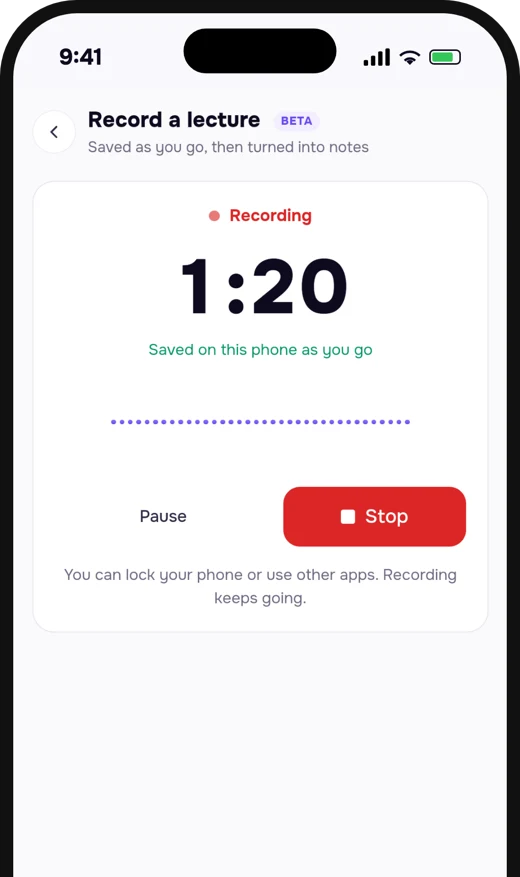
Listen in class. Nuros writes the notes.
- ✓Press record when class startsOn your laptop or phone. Saved as you go, so nothing is lost.
- ✓Notes when class endsNuros turns the lecture into structured notes you can quiz and turn into flashcards.
- ✓Play it back with the transcriptFind exactly what your professor said, right in the note.
- ✓On every plan1 hour free, 6 hours a month on Plus, unlimited on Premium.
Smart notes that understand context
Structured notes from any source — PDF, link, YouTube, or a topic.
Classical conditioning is a form of associative learning in which a neutral stimulus, after repeated pairing with a stimulus that naturally triggers a response, comes to trigger that response on its own. It matters because Ivan Pavlov's experiments with dogs around 1900 and Watson and Rayner's 1920 "Little Albert" study showed that physical and emotional responses can be learned — a foundation of behaviorism and of modern exposure therapy for phobias.
This note explains:
- Pavlov's Experiments
- Unconditioned vs. Conditioned Stimuli
- Acquisition and Timing
- Extinction and Spontaneous Recovery
- Generalization and Discrimination
- Little Albert and Conditioned Emotions
- Classical vs. Operant Conditioning
- Applications in Therapy
Every classical conditioning setup has four parts: an unconditioned stimulus (food) that naturally produces an unconditioned response (salivation), and a conditioned stimulus (a metronome) that, once learned, produces a conditioned response…
 AI
AIYour personal AI study assistant
A mentor that knows your notes and adapts to you.
Nuro AI
Your smart, personalized learning assistant
- Unconditioned stimulus (US) — naturally triggers a response without learning, like food making Pavlov's dogs salivate.
- Conditioned stimulus (CS) — a neutral cue, like a metronome, that triggers the response after being paired with the US.
- Acquisition — the association builds over repeated pairings, fastest when the CS comes just before the US.
- Extinction & spontaneous recovery — the response fades when the CS appears alone, then can briefly return after a rest.
- Little Albert (1920) — Watson and Rayner showed emotions like fear can be conditioned too.
Here's a quick quiz on Classical Conditioning. Ready?
- 1.In Pavlov's experiments, what was the unconditioned stimulus?
- 2.What is it called when a conditioned response fades because the conditioned stimulus keeps appearing without the unconditioned stimulus?
- 3.Which researchers conditioned a fear of a white rat in "Little Albert"?
- 4.What is it called when a response also occurs to stimuli similar to the conditioned stimulus?
- 5.How does classical conditioning differ from operant conditioning?
Upload your syllabus. Get a plan to the final.
Nuros reads your course syllabus — topics, quiz and exam dates, days off — and turns it into a dated study plan that builds notes and quizzes week by week. Or start from any topic. Syncs with your calendar.
Turn your sources into a real exam
A timed exam from your sources — graded, with a readiness score.
Pick which types the AI may generate.
You're losing points on the Electron Transport Chain. Nuros tracks it across every quiz and exam — and your study plan adapts automatically.
Practice this concept →Take Nuros anywhere
The full Nuros experience, in your pocket.

Invest in Better Learning
Start free. Upgrade when you're ready.
Free Plan
Get the basics to begin learning.
What's Included?
Plus
Enough for one class.
Billed $59.88/year · Save 17% vs $5.99/mo
What's Included?
Premium
Built for a full course load.
Billed $95.88/year · Save 33% vs $11.99/mo · locked in forever
Just $3/mo more than Plus for unlimited
What's Included?
On every plan, including Free
Frequently Asked Questions
Everything you need to know before getting started.
Yes. The free plan includes 3 AI notes from your own class material, 3 Nuro AI chats (10 questions each), 2 practice exams with full review, 2 podcasts and 2 video lessons, plus flashcards and quizzes. It also includes all 12 AP and SAT courses with full mock exams. Plus is $5.99 a month ($4.99 billed annually) for 6 new notes and 6 mentor sessions every month. Premium is $11.99 a month ($7.99 billed annually) for unlimited notes and mentor sessions, plus exams from your own sources. Podcasts and video lessons are included on every plan: 2 of each on Free, 6 of each a month on Plus, unlimited on Premium. Lecture recording too: 1 hour on Free, 6 hours a month on Plus, unlimited on Premium.
Plus ($5.99 a month, or $4.99 billed annually) gives you 6 new notes and 6 Nuro AI mentor sessions every month. Premium ($11.99 a month, or $7.99 billed annually) gives you unlimited notes and mentor sessions, exams generated from your own sources, unlimited study plans and faster AI responses. Podcasts and video lessons come with every plan: 2 of each on Free, 6 of each every month on Plus, unlimited on Premium. Lecture recording works the same way: 1 hour on Free, 6 hours every month on Plus, unlimited on Premium.
College students studying for midterms and finals, and high school students preparing for AP, SAT, and ACT exams. If your class gives you slides, readings, or notes, Nuros can build your study materials from them.
Yes. Record the lecture itself, or upload lecture slides, readings, PDFs, or your own notes from any course — organic chemistry, intro psych, data structures, economics — and Nuros turns them into study notes, flashcards, quizzes, and practice exams. ARC then tracks which concepts you keep missing and brings them back before your midterm or final.
Yes. Upload your course syllabus and Nuros turns its topics, quiz and exam dates into a dated study plan, building notes and quizzes a week at a time. Lecture slides work as PowerPoint files (.pptx) — export Google Slides as .pptx first — along with PDFs, Word documents, photos of handwritten notes, and YouTube links.
Nuros is designed specifically for learning. It helps you organize notes, track progress, and build study plans, not just generate answers.
Yes — Nuros is especially effective for SAT and AP prep. Generate study notes, flashcards, and full practice exams from your own materials, then let ARC resurface the concepts you keep missing so you focus on what actually costs you points.
No. Nuros (with an “s”) is an AI adaptive learning app for students, made by Nuros Learning LLC. It's a separate, unrelated company from Nuro, Nuro Retention, and other similarly named businesses.
Students use Nuros to revise faster, remember better, and stay consistent — which supports stronger academic performance over time.
ARC is the loop at the heart of Nuros. Nuros uses your study performance to identify weak concepts and bring them back for targeted review. It helps you decide what to revisit next.
Every attempt — quizzes, flashcards, and graded exams — updates a per-concept mastery score. ARC reads those scores to surface your weakest concepts first and decide what to resurface, and when.
Yes. Missed concepts come back re-explained from a new angle, then re-enter your review queue on a spaced schedule and keep returning until your mastery holds — so nothing important slips through before your test.
Your notes are private by default. You control whether to share them with others. See our Privacy Policy for how we handle your data.
Yes. Your account works across phone, tablet, and desktop with automatic syncing.
Yes. You can cancel your subscription anytime from your account settings — and you keep access to the notes you've already created.
Stop studying what you already know.
Bring in tonight's reading and let Nuros find the gap that's actually going to cost you on your next midterm.